Surveys, quizzes, feedback cards and sign-up sheets — each with its own link and its own dynamic QR code. Put the code on a table, a poster or a whiteboard, and the answers arrive as charts, a ranking and a spreadsheet, while the code stays the same whatever you change.
Create a form — start free
A feedback email sent the next morning is answered by the people who were already going to answer it. The table card at the end of the meal, the poster by the exit of a talk, the QR code on the last slide of a class — those reach everybody who was in the room, while what they think is still fresh. That is where a form belongs, and it is why every form here comes with its own dynamic QR code rather than a link you have to shorten and paste somewhere yourself.
The page a respondent lands on is built for a phone at arm’s length: large targets, one question after another, sections as steps, and a submit button a thumb can reach. It opens in a second on a weak signal, it follows the phone into dark mode, and an Arabic form is drawn right to left with the buttons and messages translated.
You choose what the form is for when you create it, and it arrives with sensible questions and settings already in place. A survey gathers information and can be fully anonymous — no name, no email, and no record of the respondent’s network. A quiz (QCM) has correct answers, points and a pass mark, and can be timed, shuffled and limited to one attempt. A feedback form asks for a rating and a Net Promoter Score and leaves a way to reply. A registration collects names and emails, closes on a date, and stops at the number of seats you have.
Eleven question types cover almost everything: short and long text, single and multiple choice, dropdowns, ratings from 1–5 or 1–10, yes or no, numbers, email addresses, phone numbers and dates. Each is checked on our side before it is stored, so a phone number field holds phone numbers.
Mark the right answers once and every submission is scored the moment it arrives. The correct answers never reach the participant’s phone: the page only knows the questions, so opening the page source reveals nothing. A time limit is kept by our server from the moment somebody presses Start, and reloading the page resumes the same attempt rather than resetting the clock.
Afterwards you choose what each participant sees — their score, the full correction with your explanations, or simply a thank-you. You see a ranking by score and then by time taken, the pass rate, and the success rate of every question, which is the list of what to teach again.
Every choice and rating question gets its own chart, text answers are listed, and short answers that repeat are counted together. Export everything as a CSV that opens straight in Excel — accents and Arabic included — or, on Pro and Teams, as a branded PDF report for a meeting. On the Teams plan, colleagues can build and read forms with you, and a form’s results can appear in a client’s read-only portal, without names or contact details.
And because the QR code is dynamic, the printed code never has to change: close one form and point the same code at the next, or restyle it in QR Studio, and every poster already on a wall follows.
What the feature actually does, part by part.
One click gives the form its own code, with scan analytics and your brand template — and it can be re-pointed after it is printed.
Correct answers, points, pass mark, time limit, shuffling and one attempt per participant, all marked on the server.
Ratings and a Net Promoter Score calculated for you, with promoters, passives and detractors counted.
Stops at the number of places you have, closes on a date, and says how many places are left if you want it to.
Large targets, sections as steps, dark mode and right-to-left Arabic, on a page that loads on half a bar of signal.
A summary for every question, a leaderboard for quizzes, and the success rate of every question.
A spreadsheet that opens in Excel with every accent intact, and a branded PDF report on Pro and Teams.
Copy one line of HTML and the form runs inside your own website as well.
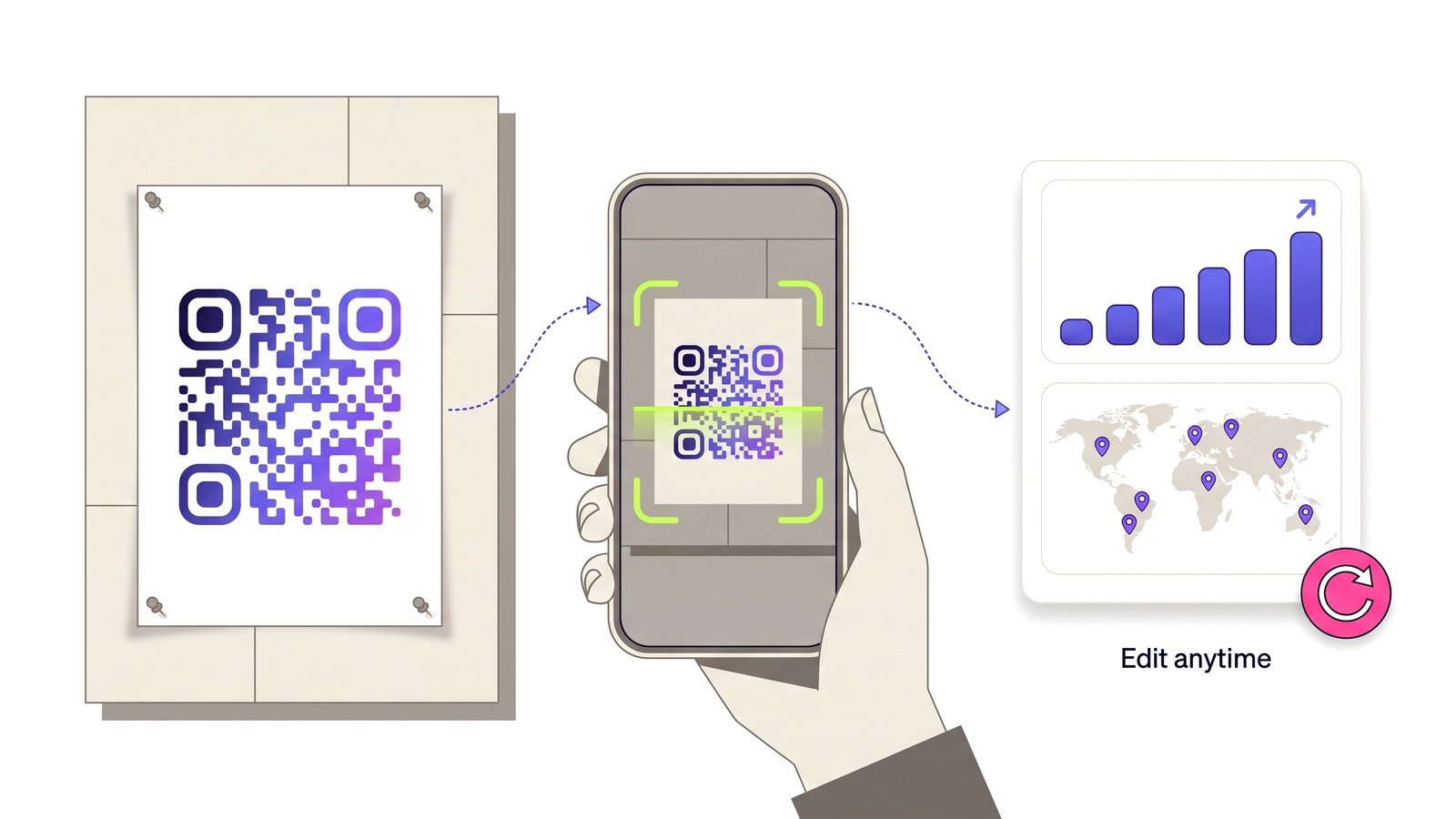
Anywhere a question is best asked in person, on paper, at the moment it matters.
No technical knowledge required.
Open Forms and pick a survey, a quiz, a feedback form or a registration.
Edit the questions it starts with — add, reorder, mark the right answers.
Publish, then create the form’s QR code with one click.
Print the code; answers, charts and scores appear as people respond.
Taken from the live plan matrix, so this page and your account always agree.
See the full plan comparison for everything each tier includes.
Straight answers to what usually decides whether this is the right tool for the job.